
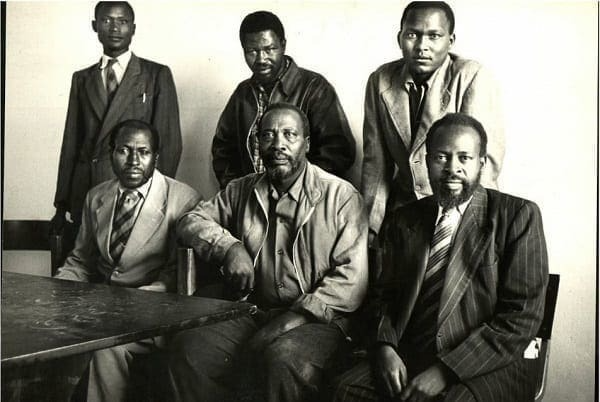
Kenya marks Mashujaa Day on 20 October, the national day of heroes. Mashujaa means “heroes” in Kiswahili: it is the day the country remembers the women and men whose courage and commitment helped shape the nation.
The date is not incidental. On 20 October 1952, the British colonial government declared a State of Emergency in Kenya, opening one of the harshest phases of the struggle for independence. That same night, dozens of nationalist leaders were arrested, including the group that went down in history as the Kapenguria Six.
Who were the Kapenguria Six
Six men were tried at Kapenguria, a remote location in north-western Kenya, charged with managing Mau Mau, an underground movement outlawed by the colonial authorities, and with conspiring to murder every white settler in Kenya. The trial, opened on 3 December 1952 before Judge Ransley Thacker, concluded in April 1953 with all six defendants convicted and sentenced to seven years of hard labour, followed by a period of restriction on their personal freedom. Later historians have extensively documented the trial’s irregularities, including unreliable testimony and pressure placed on the judge by the colonial government.
- Jomo Kenyatta, formerly president of the Kenya African Union, was the best known of the defendants. Released in 1961, he led Kenya to independence in 1963 as its first prime minister and, the following year, became its first president.
- Bildad Kaggia, a trade unionist and political organiser, was released shortly after 1961 and later elected to Parliament, also serving as Assistant Minister for Education.
- Kung’u Karumba, a businessman and one of the founders of Mau Mau, is the only one of the six who never entered Parliament after independence: he disappeared in 1975 during a business trip to Uganda and was never found.
- Fred Kubai, a trade unionist and former telegraph worker, was elected MP for Nakuru East from 1963 to 1974 and again from 1983 to 1988.
- Paul Ngei was released shortly after 1961 and later served as a minister in governments led by Kenyatta.
- Achieng’ Oneko, a journalist and activist, was, in a bitter irony, detained again between 1969 and 1974 by Kenyatta’s own government, before returning to Parliament in later years.
Kenyatta in Maralal
Few people know that the final stop of Kenyatta’s long imprisonment and restriction was right here in Maralal, just a few steps from where we work today. After seven years of hard labour at Lokitaung prison in Kenya’s far north and two years under house arrest in Lodwar, on 11 April 1961 Kenyatta was moved to a house on the edge of Maralal, where he remained until his final release on 14 August 1961.
The house, now known as Kenyatta House, is managed by the National Museums of Kenya as a national monument and holds period photographs, original furniture and the telephone used by the Kenyatta family. According to local tradition and the museum’s own guides, it was in this house that Kenyatta finished Facing Mount Kenya, his well-known study of Kikuyu culture, working at a desk facing the window from which, on clear days, the peak of Mount Kenya can still be seen — the source, according to this account, of the book’s title.
In the interest of historical accuracy, it’s worth noting that the academic record tells a different story: Facing Mount Kenya was actually written in London in the 1930s, as Kenyatta’s anthropology thesis at the London School of Economics under the supervision of Bronisław Malinowski, and published in 1938, fourteen years before the Kapenguria trial. What remains certain and striking, though, is that Kenyatta spent the final months of his imprisonment right here in Maralal, and that this house, with its view of Mount Kenya, has become part of the collective memory of the town where we work every day.
British colonialism and the fight for independence
To understand the Kapenguria trial, it helps to look at what preceded it. From the 1920s, the British colonial administration had reserved central Kenya’s most fertile land, the so-called “White Highlands,” for European settlers, pushing hundreds of thousands of Kenyans, mostly Kikuyu, onto increasingly poor land or into wage labour on settler farms. This inequality in access to land was one of the deep causes of the Mau Mau uprising.
After the declaration of the State of Emergency in October 1952, the British government responded with large-scale repression. Between 1952 and 1960, by some estimates at least 70,000 people suspected of supporting the movement were detained without trial, for periods of between two and six years, in a system of camps known as “the Pipeline”; some reconstructions put the number as high as 150,000 detainees. Conditions in the camps included forced labour and widespread violence, documented through testimony gathered decades later. In 1959, the death of eleven detainees at Hola camp, initially blamed by the authorities on contaminated water but in fact caused by beatings from guards, caused a scandal that helped accelerate the end of British colonial rule in Kenya.
The official toll at the time cited 32 European settlers killed, against more than 1,800 African civilians, over 3,000 African police and soldiers, and around 12,000 Mau Mau fighters. More recent research and the Kenya Human Rights Commission suggest a far higher overall toll, once deaths, torture and disappearances are accounted for. Kenya gained independence on 12 December 1963, with Jomo Kenyatta, the former Kapenguria defendant, as the free country’s first head of government.
A book to go further
For anyone who wants to go deeper into this history, we recommend Histories of the Hanged: Britain’s Dirty War in Kenya and the End of Empire (2005), by British historian David Anderson. Drawing on testimony gathered from more than 800 trials of the period and on archives that remained inaccessible for decades, the book reconstructs the violence of the conflict on both sides and documents how, between 1953 and 1956, more than a thousand Kenyans were sentenced to death and hanged, often on flimsy or fabricated charges: the largest-scale use of capital punishment anywhere in the history of the British Empire.
Who are today’s heroes
Since 2010, under Kenya’s new Constitution, Mashujaa Day has replaced the earlier Kenyatta Day: no longer the celebration of a single figure, but a broader recognition of all the people who contributed to the country’s path to freedom. It is also an occasion to ask who the heroes in our own communities are today: those who teach, mentor, organise, care for others and create opportunities, often without recognition. It’s a question that feels close to us, as an organisation that works every day alongside students, teachers and families in Maralal.
Sources: David Anderson, Histories of the Hanged: Britain’s Dirty War in Kenya and the End of Empire (2005); Wikipedia, “Kapenguria Six” and “Facing Mount Kenya”; Imperial War Museum, “The Kenya Emergency Explained”; National Museums of Kenya, Kenyatta House (Lodwar and Maralal).